



01 | NATIONAL RULES
Metal Detecting Rules in the Netherlands
What does Dutch heritage legislation say? How deep can you dig, when do you need permission and where does the exemption not apply?
Read the national rules →
What are the rules for metal detecting in the Netherlands? Learn where you can search, what permissions you need, how to report archaeological discoveries and what to do if you find dangerous objects.
DETECT KNOWLEDGE CENTRE | LAWS & REGULATIONS
Can you use a metal detector anywhere in the Netherlands? No. Metal detecting is permitted under certain conditions, but not everywhere.
Before you start searching, you need to consider Dutch national legislation, local regulations, permission from the landowner and the protection of archaeological heritage.
At Detect Metaaldetectors, we explain the most important rules in straightforward language. From maximum digging depth and permitted locations to reporting archaeological discoveries and dealing with potentially dangerous objects.
Under certain conditions, Dutch law provides an exemption from the general archaeological excavation prohibition for metal detector users searching on land. However, this exemption does not mean you can search anywhere.
The exemption for archaeological detecting permits disturbance of the ground to a maximum depth of 30 centimetres.
Always obtain permission from the landowner or another legally authorised person before detecting.
Municipalities may prohibit metal detecting in particular areas or throughout their municipality.
The standard exemption does not apply to protected archaeological monuments or ongoing excavations.
Archaeological excavation in underwater sediments is not covered by the metal detecting exemption.
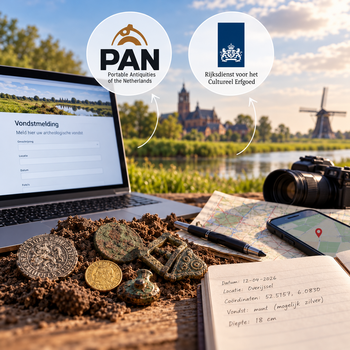
Archaeological discoveries must be reported. This can be done through PAN or the Dutch Cultural Heritage Agency (RCE).
This is a summary of the main rules. The detailed articles explain the requirements and exceptions.
Choose the subject you want to learn more about. All five guides cover regulations in the Netherlands, not the laws of the United Kingdom, Ireland or other countries.
01 | NATIONAL RULES
What does Dutch heritage legislation say? How deep can you dig, when do you need permission and where does the exemption not apply?
Read the national rules →02 | DETECTING LOCATIONS
Can you detect in fields, pastures, on beaches, in parks or forests? Learn how to determine whether a specific location is permitted.
Explore detecting locations →03 | REGIONAL RULES
Explore practical guidance for all twelve Dutch provinces and learn how to check current municipal restrictions.
View all provinces →04 | ARCHAEOLOGICAL DISCOVERIES
Found an old coin, brooch or other historical object? Learn when reporting is required, how PAN works and what happens next.
Learn how to report finds →05 | SAFETY
What should you do if you discover a coin hoard, an old firearm, ammunition or possible human remains? Learn when to stop and who to contact.
Read the safety guidance →Check these four points before heading out:
Stop detecting immediately. Do not touch or move the object. Keep your distance and prevent others from approaching. In the Netherlands, call 112 and follow the instructions of emergency services.
For the latest legislation, local rules and reporting procedures, consult these official Dutch resources:
This page provides general information, not legal advice. Local rules and regulations may change. Always check the rules that apply to your intended detecting location.
At Detect Metaaldetectors, we believe metal detecting should be enjoyable while respecting history, landowners and the environment.
That's why we share practical information about regulations, reporting finds and safety alongside our product advice.
Need help choosing a metal detector? You're welcome to visit our showroom in Almelo, the Netherlands, for personal advice.